Synopsis
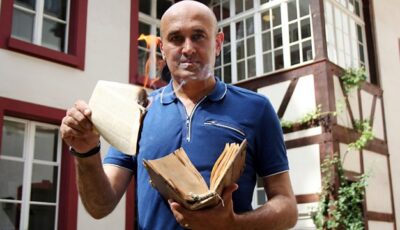
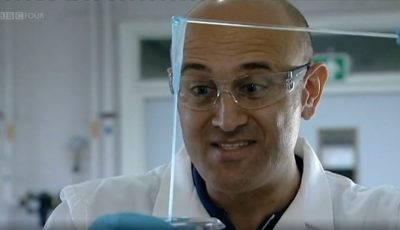
Phosphorus was discovered when Brandt was attempting to isolate gold from his urine.
- Programme: Chemistry: A Volatile History
- Episode: 01: Discovering the Elements
- Channel: BBC Four
- Broadcast year: 2010
- Chemistry
Licence: ERA Licence required
Free to watch for UK schools, colleges and universities with an ERA Licence
UK only
Staff and students of licensed education establishments only
Cannot be adapted
Add Notes
More clips from Chemistry: A Volatile History
01: Discovering the Elements | Chemistry: A Volatile History
The story of how the elements were discovered and mapped begins with the alchemists who questioned that the worl...
Hydrogen | Chemistry: A Volatile History
Cavendish accidentally discovered hydrogen, the first elemental gas, when experimenting with air.
Lavoisier's Elements | Chemistry: A Volatile History
Lavoisier was the first scientist to define what an element was.
Mercury | Chemistry: A Volatile History
Mercury is fourteen times heavier than water, and so dense even a steel bolt will float in it.
Oxygen | Chemistry: A Volatile History
The story of how Joseph Priestley discovered oxygen.
Properties of Potassium | Chemistry: A Volatile History
Spec references J248: C4.1a J250: C4.1a. Professor Jim Al-Khalili describes properties of potassium and some of its u...
More resources about The Periodic Table trends and history
02: The Order of the Elements | Chemistry: A Volatile History
Professor Jim Al-Khalili looks at how the early scientists' bid to decode the order of the elements was driven ...
01: Discovering the Elements | Chemistry: A Volatile History
The story of how the elements were discovered and mapped begins with the alchemists who questioned that the worl...
Hydrogen | Chemistry: A Volatile History
Cavendish accidentally discovered hydrogen, the first elemental gas, when experimenting with air.
Bunsen Burner | Chemistry: A Volatile History
Robert Bunsen was a German chemist responsible for the invention of the Bunsen Burner.
Oxygen | Chemistry: A Volatile History
The story of how Joseph Priestley discovered oxygen.
Arrangment of the Periodic Table | Curriculum Bites
Spec references J248: C2.2a, C2.2b, C2.2c J250: C2.2a, C2.2b, C2.2c. This video explains the arrangement of the periodic ...
Mendelleev's Periodic Table | Chemistry: A Volatile History
Spec references J248: C2.2i J250: C2.2i. An account of how Mendeleev arranged the elements by atomic mass to crea...
Properties of Group 1 Metals | Chemistry: A Volatile History
Spec references J248: C4.1a. Demonstration of reactions of lithium, sodium and potassium with water (Contains hi...
Gallium | Chemistry: A Volatile History
Gallium is in a liquid state over the widest range of temperatures than any other element.
Helium | Chemistry: A Volatile History
Norman Lockyer recorded a new yellow line by observing the sun through London smog and, assuming the new element to be a metal, named ...
Lavoisier's Elements | Chemistry: A Volatile History
Lavoisier was the first scientist to define what an element was.
Mercury | Chemistry: A Volatile History
Mercury is fourteen times heavier than water, and so dense even a steel bolt will float in it.
Periodic Table Overview | Chemistry: A Volatile History
Spec references J248: C2.2i J250: C2.2i. A quick recap of how the periodic table is arranged including groups, period...
Properties of Potassium | Chemistry: A Volatile History
Spec references J248: C4.1a J250: C4.1a. Professor Jim Al-Khalili describes properties of potassium and some of its u...
Silicon | Chemistry: A Volatile History
Silicon was discovered by Jöns Jacob Berzelius, a Swedish chemist, in 1824 by heating chips of potassium.
More from Jim Al-Khalili
Nylon | Chemistry: A Volatile History
Jim Al-Khalili reveals the breakthroughs which harnessed elements' ability to release vast power, showing how scientists are trying to ...
Einstein and the beetle | Gravity and Me: The Force that Shapes our Lives
Professor Jim Al-Khalili explains Einstein's analogy of gravity that he told his son to explain his...
Prof Jim Al Khalili goes inside Calder Hall for his first look inside the core of a nuclear reactor | Britain's Nuclear Secrets: Inside Sellafield
Nuclear physicist Professo...
Sarah-Jayne Blakemore on teenage brains | The Life Scientific
Professor Sarah-Jayne Blakemore talks to Jim Al-Khalili about her research on the developing teenage brain.
The race to prove Maxwell's theory | Shock and Awe: The Story of Electricity
Jim Al-Khalili explains how physics professor Oliver Lodge proved Maxwell's theory that electrom...
Fukushima: Is Nuclear Power Safe? | Horizon
Six months after the explosions at the Fukushima nuclear plant in Japan, Professor Jim Al-Khalili sets out to discover whether nu...
Arabic, the language of God | Science and Islam
Jim Al-Khalili looks at how Islamic caliphs encouraged scientific research and made Arabic the official language of their vas...
Introduction to Electronic Structure and Chemical Properties | Atom
Spec references J248: C2.2h J250: C2.2h. Professor Jim Al-Khalili explains how chemical properties are de...
Electrolysis - Discovery of Potassium | Curriculum Bites
Spec references J248: C3.4b J250: C3.4b. Professor Jim Al-Khalili recreates the electrolysis experiment that lead to...