Synopsis
Animated shorts to support students preparing for assessments in GCSE Additional Science.
- Programme: GCSE Bitesize Revision
- Episode: Additional Science 2
- Channel: BBC Two
- Broadcast year: 2010
- Science
Licence: ERA Licence required
Free to watch for UK schools, colleges and universities with an ERA Licence
UK only
Staff and students of licensed education establishments only
Cannot be adapted
Add Notes
More clips from GCSE Bitesize Revision
Alternating and direct current | GCSE Bitesize Revision
Spec references J249: P8.2h J250: P6.2g. Alternating and direct current. Description and animation.
Attraction and repulsion | GCSE Bitesize Revision
Spec references J249: P3.1b J250: P3.1b. Attraction and repulsion between objects ( charging by induction not addressed) - ...
Biological compounds | GCSE Bitesize Revision
Animated shorts to support students preparing for assessments in GCSE Additional Science.
Chemical Calculations (J250) | GCSE Bitesize Revision
Spec references J250: C2.1. This video provides an overview of how the masses of subatomic particles are used to calcul...
Chemical calculations | GCSE Bitesize Revision
This video provides an overview of how the masses of subatomic particles are used to calculate atomic masses. It then explains...
Dangers and nuisance of electrostatics | GCSE Bitesize Revision
Spec references J249: P3.1c J250: P3.1c. Discharging charged objects and dangers nuisance of static electrici...
Electrolysis | GCSE Bitesize Revision
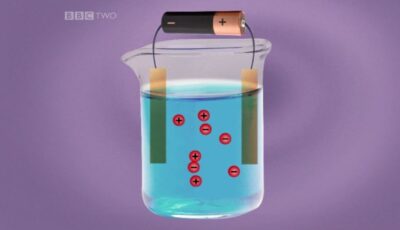
Spec references J248: C3.4a, C3.4b, C3.4c, C3.4d, C3.4e J250: C3.4a, C3.4b, C3.4c, C3.4d, C3.4e. Explanation of how ionic substances ca...
Electrolysis 2 | GCSE Bitesize Revision
Spec references J248: C3.4a, C3.4b, C3.4c, C3.4d, C3.4e J250: C3.4a, C3.4b, C3.4c, C3.4d, C3.4e. Explanation of how ionic substances ...
Electrostatics | GCSE Bitesize Revision
Animated shorts to support students preparing for assessments in GCSE Additional Science.
Force arrows and balanced forces | GCSE Bitesize Revision
Spec references J249: P2.2c, P2.2d, P2.2f J250: P2.2c, P2.2d, P2.2f. Force arrows and balanced forces - animation a...
Force, mass and acceleration | GCSE Bitesize Revision
Spec references J249: P2.2i, P2.2l J250: P2.2i. Effect of force and mass on acceleration. F = m a. Worked example. Anim...
Forces and moving objects | GCSE Bitesize Revision
Spec references J249: P2.2a, P2.2b, P2.3h J250: P2.2a, P2.2b, P2.3h. Clear description and explanation of types of force a...
Forces when falling and terminal velocity | GCSE Bitesize Revision
Spec references J249: P2.2f, P2.2h J250: P2.2f, P2.2h. Falling, air resistance, balanced forces and termin...
Inheritance | GCSE Bitesize Revision
Spec references J247: B5.1i, B5.1j J250: B5.1g, B5.1h. Summary of inheritance including: dominant and recessive alleles, genetic diagram...
Light and sound waves | GCSE Bitesize Revision
Animated shorts to support students preparing for assessments in GCSE Additional Science.
Mains electricity 2 | GCSE Bitesize Revision
Animated shorts to support students preparing for assessments in GCSE Additional Science.
Nuclear fission | GCSE Bitesize Revision
Spec references J249: P6.2. Description and animation of nuclear fission.
Nuclear fission and fusion | GCSE Bitesize Revision
Animated shorts to support students preparing for assessments in GCSE Additional Science.
Nuclear fusion | GCSE Bitesize Revision
Spec references J249: P6.2. Description and animation of nuclear fusion.
Parallel and series circuits | GCSE Bitesize Revision
Spec references J249: P3.1e, P3.1f, P3.2a, P3.2b J250: P3.1d, P3.1e, P3.2a, P3.2b. Circuit symbols, differences between...
More resources about Science
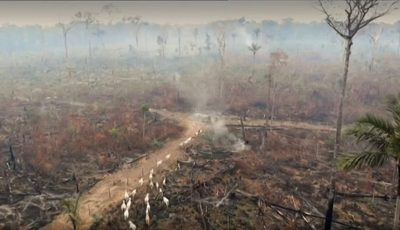
Amazon deforestation | Meat: A Threat to Our Planet?
Liz Bonnin witnesses the devastation of the Amazon rainforest from the sky.
Meat: A Threat to Our Planet?
From colossal farms in America to the destruction of the Amazon, Liz Bonnin investigates how our hunger for meat is killing our planet.
Episode 1 | Orbit: Earth's Extraordinary Journey
Kate Humble and Dr Helen Czerski follow the Earth's voyage around the sun for one complete orbit, travelling first from July...
The pollination process | The Private Life of Plants
David Attenborough describes the process of pollination and how this helps plants reproduce.
Keeping cool | Nature's Microworlds
The Namaqua chameleon has developed an ingenious tactic to avoid the heat of the Namib desert.
Cauldron of Life | Galapagos
Liz Bonnin joins a scientific team aboard the research vessel the Alucia on an expedition across the Galapagos Island.
How hurricanes are formed by Earth's rotation | Learning Zone
Physicist Helen Czerski explains that hurricanes happen because the earth is rotating. She shows how, because t...
Orbit: Earth's Extraordinary Journey | Learning Zone
Kate Humble and Dr Helen Czerski follow the Earth's voyage around the sun for one complete orbit, to witness the astonis...
The smallest fox with the biggest ears! | Super Cute Animals
The fennec's ears help it to survive in the heat of the desert dunes.
06: Coasts | Blue Planet II
The wildlife series narrated by David Attenborough explores the planet's coasts. They are the most changeable of the ocean worlds, but they offer...
Can Scientists Save the World? | Panorama
Richard Bilton meets the scientists trying to save the world from the consequences of climate change and investigates whether they...
Cotton production and the Aral Sea crisis | Stacey Dooley Investigates
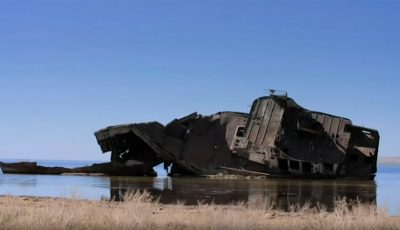
Stacey Dooley visits the Aral Sea Basin in Kazakhstan, which has almost entirely dried up due to cotto...
Desert amphibians | Life in Cold Blood
Spadefoot toads can stay underground in a state of suspended animation for years, but when they emerge they must feed and breed before...
S03E12: North of England | Local Heroes
Adam Hart-Davis recalls William Sturgeon's inventing the electric motor and James Nasmyth's steam hammer Adam also sees Joseph Paxton...
01: Travelling | The Private Life of Plants
David Attenborough begins his incredible journey into the world of plants with a look at how plants move from place to place.
03: Coral Reefs | Blue Planet II
The wildlife documentary series narrated by David Attenborough reveals the ingenious ways life exists in the undersea cities of tropical reefs.
04: Desert Worlds | The Green Planet
Desert plants spend decades in suspended animation waiting for rain, or they travel to find it. They survive using weapons, camouflage a...
Cattle feedyard | Meat: A Threat to Our Planet?
Liz Bonnin visits a cattle feedyard, a mass factory farm, that contains about 50,000 cows.
Climate change and greenhouse gases | Climate Change: The Facts
A discussion of the devastating impact of burning fossil fuels.
02: Growing | The Private Life of Plants
David Attenborough continues his incredible journey into the world of plants. Remarkable time-lapse photography reveals how new leav...