Synopsis
Andrew Graham-Dixon investigates Pop Art as a reflection of consumerism in Postwar America.

- Programme: Art of America
- Episode: 03: What Lies Beneath
- Channel: BBC Four
- Broadcast year: 2011
- History | America, 1713-1975 | The USA 1930-54 | Post-war America, 1945-1954
Licence: ERA Licence required
Free to watch for UK schools, colleges and universities with an ERA Licence
UK only
Staff and students of licensed education establishments only
Cannot be adapted
Add Notes
More clips from Art of America
03: What Lies Beneath | Art of America
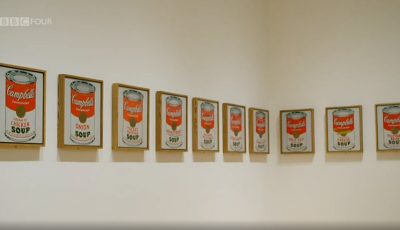
Andrew Graham-Dixon examines Andy Warhol's soup can paintings, interviews pop artist James Rosenquist, looks at Ed Ruscha's work and v...
Andy Warhol | Art of America
Andrew Graham-Dixon explores Andy Warhol and how his art, unlike anything else before, embraced consumerism.
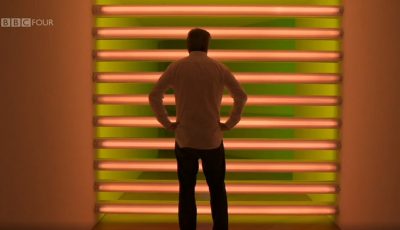
Dan Flavin | Art of America
Andrew Graham-Dixon explores Dan Flavin's famous and simple use of the fluorescent tube.
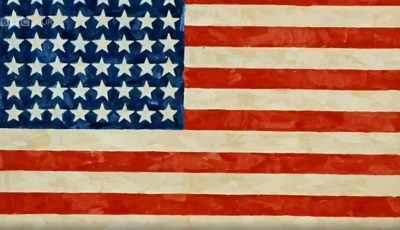
Jasper Johns | Art of America
Andrew Graham-Dixon explores the work of Jasper Johns and his take on Americanism.
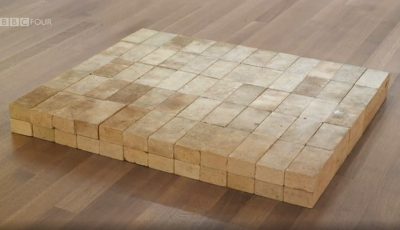
Minimalism | Art of America
Andrew Graham-Dixon explores the American response to Minimalism and its rejection of Pop Art.
Nan Goldin | Art of America
Andrew Graham-Dixon explores the evolution of post-modernism in relation to Nan Goldin and her revolutionary photographs of the AIDs crisis.
Postwar suburban America | Art of America
Andrew Graham-Dixon discusses life in America during the Cold War.
More resources about The Cold War
05: 1968 Vietnam | Peter and Dan Snow: 20th Century Battlefields
Peter and Dan Snow reveal the techniques use by US marines to flush out Communist fighters who lived in a ne...
The Cold War: 01: Berlin 1945-48 | History File
Compilation of secondary schools programme about the Cold War, featuring Berlin Crisis, Hungarian Uprising, rise of Soviet le...
S01E05: The Fall of the Berlin Wall | Days That Shook the World
Exploring the fall of the Berlin Wall in 1989 from the perspective of a Checkpoint Charlie Stasi guard comman...
S01E09: Chernobyl | Days That Shook the World
Two days highlight the benefits and terrors of atomic power: Chernobyl's nuclear meltdown on April 26, 1986.
The Cold War: 04: Cuban Missile Crisis 1962 | History File
Compilation of secondary schools programme about the Cold War, featuring Berlin Crisis, Hungarian Uprising, rise o...
11: Vietnam: 1954-1968 | Cold War
After losing the Battle of Dien Bien Phu the French leave Vietnam. A stream of refugees flee to the south after the Communist north institu...
09: The Wall: 1958-1963 | Cold War
West Germany, and West Berlin, become more affluent, prompting a surge of East Germans to cross the borders in Berlin, kept open under the...
01: Comrades: 1917-1945 | Cold War
Both the United States and the Soviet Union drifted apart after the Russian Revolution of 1917, the Russian Civil War and the Paris Peace ...
02: Iron Curtain: 1945-1947 | Cold War
The wartime allies demobilise - the United States enjoys its economic strength and resurgence while Britain and the rest of Europe is ...
Learning Zone | Strange Days: Cold War Britain
A version made specially for schools of the BBC Two history series on Britain and the Cold War. Presented by Dominic Sandbrook.
04: Berlin: 1948-1949 | Cold War
By 1947, the United States placed as a high priority the revival of the German economy, an approach opposed by the Soviet Union. After the i...
08: Age of Extremes | Andrew Marr's History of the World
In this episode, Andrew Marr brings the story right up to date with the twentieth century.
Chernobyl Nuclear Disaster | Surviving Disaster
In April 1986 a blast at a Soviet nuclear plant emits 400 times more radiation than the bomb at Hiroshima-the UN claims it ha...
06: Things Fall Apart (January 1968-June 1968) | The Vietnam War
North Vietnamese and Viet Cong forces launch surprise attacks on cities and military bases.
01: Deja Vu (1858-1961) | The Vietnam War
Revolutionaries led by Ho Chi Minh end French colonial occupation. Vietnam is divided in two at Geneva.
04: 1951 Korea | Peter and Dan Snow: 20th Century Battlefields
Peter and Dan Snow, at the border between North and South Korea, tell of two key moments in the years of fight...
10: Cuba: 1959-1962 | Cold War
Fidel Castro comes to power following the Cuban Revolution. Cuba aligns itself with the Soviet Union and the government starts nationalising A...
When The Wind Blows (1986)
Based on the work of Raymond Briggs, this chilling yet humorous story follows an elderly couple as they muddle through a nuclear attack, placing t...
05: Korea: 1949-1953 | Cold War
Korea after the Second World War was occupied by both the Soviets and the Americans, who respectively installed Kim Il Sung and Syngman Rhee ...
BalloonBallon (2018)
The Strelzyk family attempt to escape from East Germany to the west in a homemade hot air balloon. In German with English subtitles.