Atoms, elements and compounds
03: The Nitrogen Cycle | Bellamy Rides Again
David Bellamy begins his trip around the nitrogen cycle in the Surrey hospital where he languished as a child suffering from acu...
Marie Curie | Icons
Marie Curie | Icons
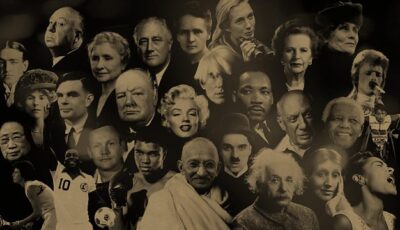
Marie Curie discovered new elements, pioneered radiotherapy and was one of the first to examine the sub-atomic world, before a scandal saw her adopted ho...
04: The Phosphorus Cycle | Bellamy Rides Again
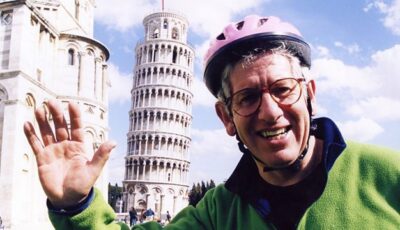
David Bellamy dances his way through an aerobics class to show how phosphorus helps turn food into energy. Then he sits in the...
Uses of Transition Metals | Short Circuit
An extra-curricular link is made to transition metals, with an explanation of how metal oxides are used to produce stained glass. T...
How are elements made? | Wonders of the Universe
Brian Cox explains what elements are and how they are formed, including the importance of carbon.
05: The Sulphur Cycle | Bellamy Rides Again
Caked from head to foot in volcanic mud, tramping the bogs of Scotland and wallowing in tropical mangrove swamps, David Bellamy l...
S04E05: North | Local Heroes
Adam Hart-Davis celebrates more pioneers of science, this week in Yorkshire and Lancashire, where he uncovers the steelmaking process that put S...
S03E09: Home Counties | Local Heroes
Hart-Davis begins by exploding balloons of hydrogen and oxygen in London, just as Henry Cavendish did in the late 18th century to prove ...
Ammonia | Short Circuit
Bringing chemistry, physics and biology to life using real-life examples, 3D graphics and practical experiments.
Aluminium | Short Circuit
Bringing chemistry, physics and biology to life using real-life examples, 3D graphics and practical experiments.
Types of Compounds | Curriculum Bites
Spec references J248: C2.2h J250: C2.2h. An introduction to how elements react to form ionic and covalent compounds, with reference to ...
Elements | Curriculum Bites
Schools science programme where topics in the double science curriculum are broken down into small chunks.
The Periodic Table trends and history
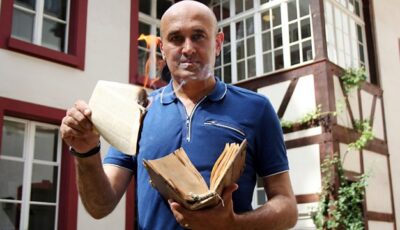
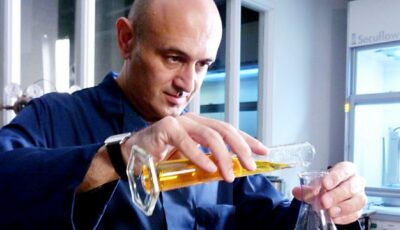
01: Discovering the Elements | Chemistry: A Volatile History
The story of how the elements were discovered and mapped begins with the alchemists who questioned that the worl...
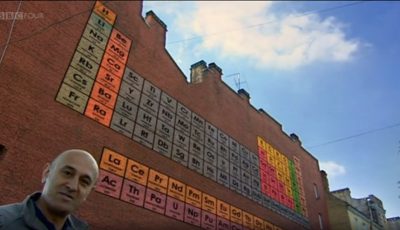
02: The Order of the Elements | Chemistry: A Volatile History
Professor Jim Al-Khalili looks at how the early scientists' bid to decode the order of the elements was driven ...
Arrangment of the Periodic Table | Curriculum Bites
Spec references J248: C2.2a, C2.2b, C2.2c J250: C2.2a, C2.2b, C2.2c. This video explains the arrangement of the periodic ...
Properties of Group 1 Metals | Chemistry: A Volatile History
Spec references J248: C4.1a. Demonstration of reactions of lithium, sodium and potassium with water (Contains hi...
Mendelleev's Periodic Table | Chemistry: A Volatile History
Spec references J248: C2.2i J250: C2.2i. An account of how Mendeleev arranged the elements by atomic mass to crea...
Bunsen Burner | Chemistry: A Volatile History
Robert Bunsen was a German chemist responsible for the invention of the Bunsen Burner.
Periodic Table Overview | Chemistry: A Volatile History
Spec references J248: C2.2i J250: C2.2i. A quick recap of how the periodic table is arranged including groups, period...
Hydrogen | Chemistry: A Volatile History
Cavendish accidentally discovered hydrogen, the first elemental gas, when experimenting with air.
Mercury | Chemistry: A Volatile History
Mercury is fourteen times heavier than water, and so dense even a steel bolt will float in it.
Helium | Chemistry: A Volatile History
Norman Lockyer recorded a new yellow line by observing the sun through London smog and, assuming the new element to be a metal, named ...
Gallium | Chemistry: A Volatile History
Gallium is in a liquid state over the widest range of temperatures than any other element.
Silicon | Chemistry: A Volatile History
Silicon was discovered by Jöns Jacob Berzelius, a Swedish chemist, in 1824 by heating chips of potassium.
Lavoisier's Elements | Chemistry: A Volatile History
Lavoisier was the first scientist to define what an element was.
Properties of Potassium | Chemistry: A Volatile History
Spec references J248: C4.1a J250: C4.1a. Professor Jim Al-Khalili describes properties of potassium and some of its u...
Oxygen | Chemistry: A Volatile History
The story of how Joseph Priestley discovered oxygen.
The discovery of phosphorus | Chemistry: A Volatile History
Phosphorus was discovered when Brandt was attempting to isolate gold from his urine.