Synopsis
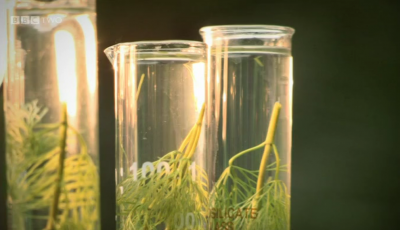
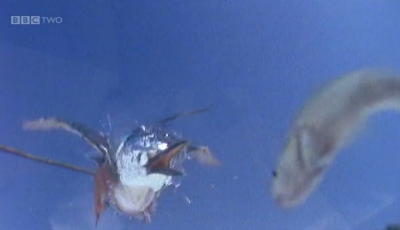
Scientists believe that our oceans are becoming more acidic due to the CO2 we are producing being absorbed by the oceans.
- Programme: Bitesize Science
- Channel: BBC Two
- Broadcast year: 2014
- Chemistry
Licence: ERA Licence required
Free to watch for UK schools, colleges and universities with an ERA Licence
UK only
Staff and students of licensed education establishments only
Cannot be adapted
Add Notes
More clips from Bitesize Science
All life needs water | Bitesize Science
Osmosis is a special type of diffusion, involving water, where molecules move from a high to a low concentration.
Beneath the surface | Bitesize Science
Microscopes continue to develop over time, giving us access to increasingly incredible magnification.
Blood Vessels | Bitesize Science
A short guide on blood vessels in the body.
Dance of the chromosomes | Bitesize Science
Mitosis is a type of cell replication that is essential to the human body's ability to grow and repair.
Endothermic and exothermic reactions | Bitesize Science
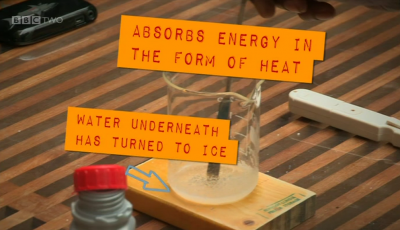
Endothermic reactions absorb heat, while exothermic reactions give off heat.
Enzyme power and food as fuel | Bitesize Science
Enzymes are biological catalysts which help us to get the energy we need from food to survive.
Germination | Bitesize Science
Seeds need the conditions to right in order to be able to germinate.
Growing bacteria | Bitesize Science
Bacteria reproduce by cloning themselves, and in the right conditions can reproduce very quickly.
Internal reflection | Bitesize Science
An examination of how light can be internally reflected, and how this is used for carrying information in fibre optic cables.
Newtons laws | Bitesize Science
Newton's laws of motion continue to underpin principles in modern day physics.
Photosynthisis | Bitesize Science
Photosynthesis is essential to life on this planet.
Solubility | Bitesize Science
Solubility is the measure of how much solute can dissolve in a solvent.
The circulatory system | Bitesize Science
A short guide on the circulatory system.
The feather and the hammer | Bitesize Science
Air resistance affects different objects and how they fall differently, just as Galileo suggested.
The force of friction | Bitesize Science
Any time one surface moves over another, there is a force of friction.
The power of invisibility | Bitesize Science
Light moves at different speeds through different objects, this can make objects appear in a different place to where they actua...
The race is on | Bitesize Science
The rate of a chemical reaction depends on the temperature, concentration, particle size and any catalysts present.
More resources about Biodiversity and human impact
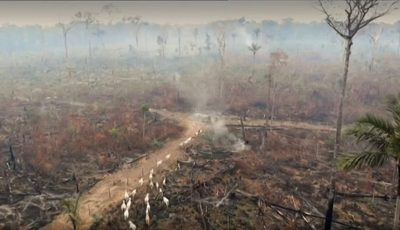
Amazon deforestation | Meat: A Threat to Our Planet?
Liz Bonnin witnesses the devastation of the Amazon rainforest from the sky.
Meat: A Threat to Our Planet?
From colossal farms in America to the destruction of the Amazon, Liz Bonnin investigates how our hunger for meat is killing our planet.
David Attenborough's 100 Years on Planet Earth
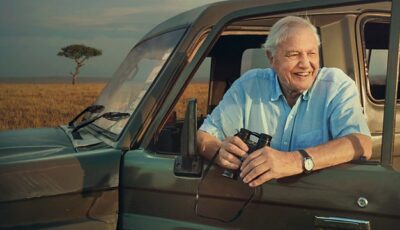
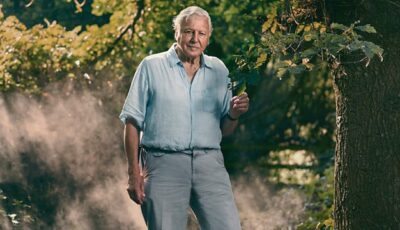
A 90-minute special, broadcast from the Royal Albert Hall, London, celebrating Sir David Attenborough's groundbreaking career ...
Keeping cool | Nature's Microworlds
The Namaqua chameleon has developed an ingenious tactic to avoid the heat of the Namib desert.
04: Galapagos: Enchanted Isles | Eden: Untamed Planet
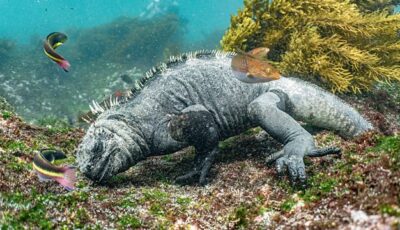
How the Galapagos became one of the most important areas of biodiversity in the world, with almost 2,000 unique species...
Cauldron of Life | Galapagos
Liz Bonnin joins a scientific team aboard the research vessel the Alucia on an expedition across the Galapagos Island.
The smallest fox with the biggest ears! | Super Cute Animals
The fennec's ears help it to survive in the heat of the desert dunes.
06: Coasts | Blue Planet II
The wildlife series narrated by David Attenborough explores the planet's coasts. They are the most changeable of the ocean worlds, but they offer...
Can Scientists Save the World? | Panorama
Richard Bilton meets the scientists trying to save the world from the consequences of climate change and investigates whether they...
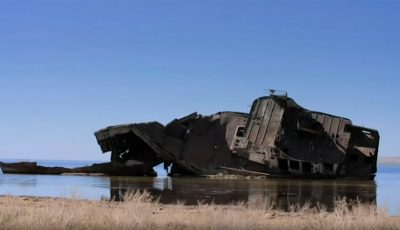
Cotton production and the Aral Sea crisis | Stacey Dooley Investigates
Stacey Dooley visits the Aral Sea Basin in Kazakhstan, which has almost entirely dried up due to cotto...
Desert amphibians | Life in Cold Blood
Spadefoot toads can stay underground in a state of suspended animation for years, but when they emerge they must feed and breed before...
03: Coral Reefs | Blue Planet II
The wildlife documentary series narrated by David Attenborough reveals the ingenious ways life exists in the undersea cities of tropical reefs.
Cattle feedyard | Meat: A Threat to Our Planet?
Liz Bonnin visits a cattle feedyard, a mass factory farm, that contains about 50,000 cows.
Climate change and greenhouse gases | Climate Change: The Facts
A discussion of the devastating impact of burning fossil fuels.
09: Plants | Life
09: Plants | Life
The nature series turns to plants and looks at the ingenious solutions that they employ to counter life's challenges, such as spring-loaded traps, suckers ...
Adaptation of Polar Bear | Life In The Snow
An exploration of how polar bears have adapted to living in freezing conditions.
Adaptation of the Arctic Fox | Life In The Snow
An exploration of how the artic fox's coat has adapted to survival in arctic winters.
Chameleon challenge | Life
While searching for a mate across the huge barren Namib desert, a female Namaqua chameleon seeks shade in the knowledge that tasty desert beetles ...
02: Great Barrier Reef | Blue Planet Revisited
To find out what the future holds for the Great Barrier Reef, scientists monitor green turtles, follow families of breeding bi...
Consumption and waste | Extinction: The Facts
The impact of consumption and waste on biodiversity.