Synopsis
The rate of a chemical reaction depends on the temperature, concentration, particle size and any catalysts present.
- Programme: Bitesize Science
- Channel: BBC Two
- Broadcast year: 2014
- Chemistry
Licence: ERA Licence required
Free to watch for UK schools, colleges and universities with an ERA Licence
UK only
Staff and students of licensed education establishments only
Cannot be adapted
Add Notes
More clips from Bitesize Science
All life needs water | Bitesize Science
Osmosis is a special type of diffusion, involving water, where molecules move from a high to a low concentration.
Beneath the surface | Bitesize Science
Microscopes continue to develop over time, giving us access to increasingly incredible magnification.
Blood Vessels | Bitesize Science
A short guide on blood vessels in the body.
Dance of the chromosomes | Bitesize Science
Mitosis is a type of cell replication that is essential to the human body's ability to grow and repair.
Endothermic and exothermic reactions | Bitesize Science
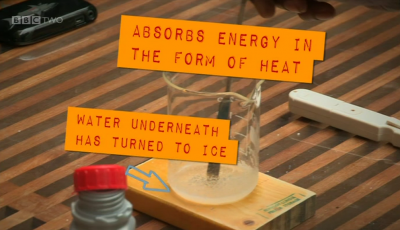
Endothermic reactions absorb heat, while exothermic reactions give off heat.
Enzyme power and food as fuel | Bitesize Science
Enzymes are biological catalysts which help us to get the energy we need from food to survive.
Germination | Bitesize Science
Seeds need the conditions to right in order to be able to germinate.
Growing bacteria | Bitesize Science
Bacteria reproduce by cloning themselves, and in the right conditions can reproduce very quickly.
Internal reflection | Bitesize Science
An examination of how light can be internally reflected, and how this is used for carrying information in fibre optic cables.
Newtons laws | Bitesize Science
Newton's laws of motion continue to underpin principles in modern day physics.
Photosynthisis | Bitesize Science
Photosynthesis is essential to life on this planet.
Solubility | Bitesize Science
Solubility is the measure of how much solute can dissolve in a solvent.
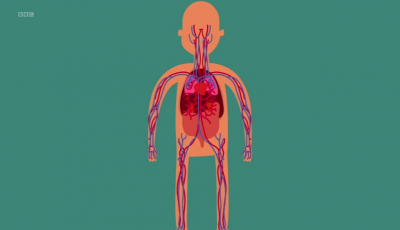
The circulatory system | Bitesize Science
A short guide on the circulatory system.
The feather and the hammer | Bitesize Science
Air resistance affects different objects and how they fall differently, just as Galileo suggested.
The force of friction | Bitesize Science
Any time one surface moves over another, there is a force of friction.
The oceans are changing | Bitesize Science
Scientists believe that our oceans are becoming more acidic due to the CO2 we are producing being absorbed by the oceans.
The power of invisibility | Bitesize Science
Light moves at different speeds through different objects, this can make objects appear in a different place to where they actua...
More resources about Chemical Changes
Biological Catalysts | Science Topics
The video provides examples of biological catalysis, such as enzyme use in cheese production and human digestion, followed by an explan...
The Haber Process | Science Topics
Spec references J248: C6.1d. The video starts with an overview of the industrial production of nitrate fertiliser through the Haber proces...
Rates of reaction | Curriculum Bites
Spec references J248: C5.2c, C5.2d, C5.2e, C5.2f J250: C5.2c, C5.2d, C5.2e, C5.2f. Introduction to rate of chemical reactions and collis...
Reactivity of Group 0, 1 and 7 | Curriculum Bites
Spec references J248: C4.1a. C4.1b J250: C4.1a. C4.1b. A detailed explanation of the reactivity of Group 0, Group 1, and Gr...
Reversible Reactions - the Haber process | GCSE Bitesize Revision
This video provides an overview of ammonia production through the Haber process, briefly touching on the ne...
Acids, Bases and Salts 2 | GCSE Bitesize Revision
Spec references J248: C3.3d, C3.3e, C3.3f, C3.3h, C4.2a J250: C3.3d, C3.3e, C3.3f, C3.3h, C3.1g. This video introduces acid...
Catalysis | Science Topics
Prog looking at catalysts and how they speed up chemical reactions, and how this knowledge is used in industry, farming and modern pollution devic...
Episode 2 | The Secrets of Everything
Science daredevil Greg Foot finds out if you could survive in a falling lift if you jump as it hits the ground, what makes chillies hot...
Measuring the Rate of Reaction | GCSE Bitesize Revision
Spec references J248: C5.2a, C5.2c, C5.2d, C5.2e, C5.2f J250: C5.2a, C5.2c, C5.2d, C5.2e, C5.2f. This video provides ...
Acids, Bases and Salts | GCSE Bitesize Revision
Spec references J248: C3.3d, C3.3e, C3.3f, C3.3h, C4.2a J250: C3.3d, C3.3e, C3.3f, C3.3h, C3.1g. This video introduces acids ...
Catalysis Demonstration | Science Topics
Catalysis is demonstrated through the decomposition of hydrogen peroxide, including a test for oxygen gas. The clip explains how cat...
Electrolysis - Discovery of Potassium | Curriculum Bites
Spec references J248: C3.4b J250: C3.4b. Professor Jim Al-Khalili recreates the electrolysis experiment that lead to...
Electrolysis | GCSE Bitesize Revision
Spec references J248: C3.4a, C3.4b, C3.4c, C3.4d, C3.4e J250: C3.4a, C3.4b, C3.4c, C3.4d, C3.4e. Explanation of how ionic substances ca...
Electrolysis 2 | GCSE Bitesize Revision
Spec references J248: C3.4a, C3.4b, C3.4c, C3.4d, C3.4e J250: C3.4a, C3.4b, C3.4c, C3.4d, C3.4e. Explanation of how ionic substances ...
Reversible Reactions | GCSE Bitesize Revision
This video provides examples of reversible chemical reactions and visually explains how dynamic equilibrium is achieved. It int...
What chemicals to use to achieve certain colours in fireworks | Rocket Science
In this classroom experiment students explore how different chemicals react when burned and le...