Synopsis
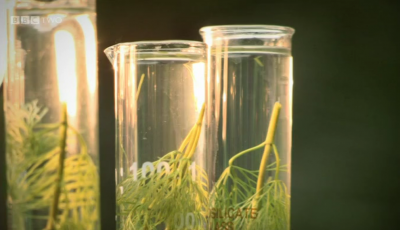
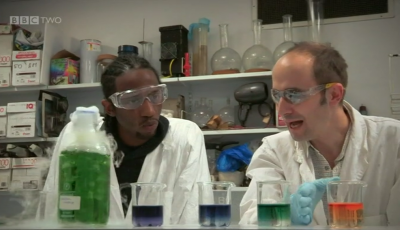
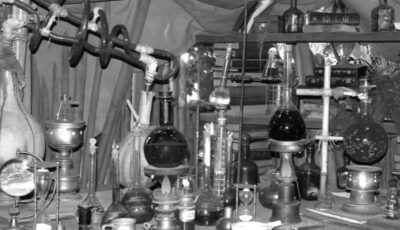
Solubility is the measure of how much solute can dissolve in a solvent.
- Programme: Bitesize Science
- Channel: BBC Two
- Broadcast year: 2014
- Chemistry
Licence: ERA Licence required
Free to watch for UK schools, colleges and universities with an ERA Licence
UK only
Staff and students of licensed education establishments only
Cannot be adapted
Add Notes
More clips from Bitesize Science
All life needs water | Bitesize Science
Osmosis is a special type of diffusion, involving water, where molecules move from a high to a low concentration.
Beneath the surface | Bitesize Science
Microscopes continue to develop over time, giving us access to increasingly incredible magnification.
Blood Vessels | Bitesize Science
A short guide on blood vessels in the body.
Dance of the chromosomes | Bitesize Science
Mitosis is a type of cell replication that is essential to the human body's ability to grow and repair.
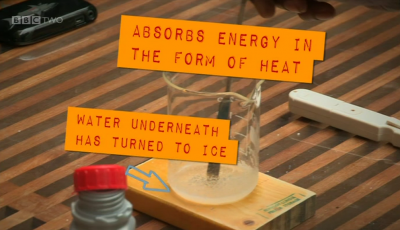
Endothermic and exothermic reactions | Bitesize Science
Endothermic reactions absorb heat, while exothermic reactions give off heat.
Enzyme power and food as fuel | Bitesize Science
Enzymes are biological catalysts which help us to get the energy we need from food to survive.
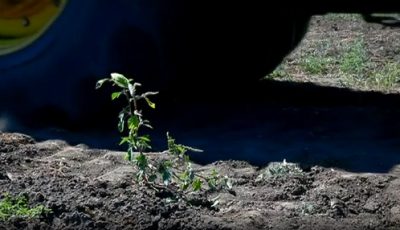
Germination | Bitesize Science
Seeds need the conditions to right in order to be able to germinate.
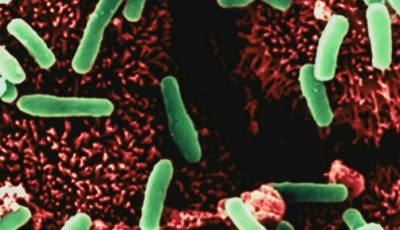
Growing bacteria | Bitesize Science
Bacteria reproduce by cloning themselves, and in the right conditions can reproduce very quickly.
Internal reflection | Bitesize Science
An examination of how light can be internally reflected, and how this is used for carrying information in fibre optic cables.
Newtons laws | Bitesize Science
Newton's laws of motion continue to underpin principles in modern day physics.
Photosynthisis | Bitesize Science
Photosynthesis is essential to life on this planet.
The circulatory system | Bitesize Science
A short guide on the circulatory system.
The feather and the hammer | Bitesize Science
Air resistance affects different objects and how they fall differently, just as Galileo suggested.
The force of friction | Bitesize Science
Any time one surface moves over another, there is a force of friction.
The oceans are changing | Bitesize Science
Scientists believe that our oceans are becoming more acidic due to the CO2 we are producing being absorbed by the oceans.
The power of invisibility | Bitesize Science
Light moves at different speeds through different objects, this can make objects appear in a different place to where they actua...
The race is on | Bitesize Science
The rate of a chemical reaction depends on the temperature, concentration, particle size and any catalysts present.
More resources about Chemistry
Episode 1 | Planet Oil: The Treasure That Conquered The World
From the moment we first drilled for oil, we opened a Pandora's box that changed the world forever. It transfor...
01: Discovering the Elements | Chemistry: A Volatile History
The story of how the elements were discovered and mapped begins with the alchemists who questioned that the worl...
Episode 2 | Planet Oil: The Treasure That Conquered The World
Professor Iain Stewart looks back at the 1950s, a time when the oil and gas fields of the Middle East became a ...
02: The Order of the Elements | Chemistry: A Volatile History
Professor Jim Al-Khalili looks at how the early scientists' bid to decode the order of the elements was driven ...
01: Metal | How It Works
Mark Miodownik traces the history of our love affair with metal. He investigates metals at the atomic level and sees how metal crystals can be grown...
03: The Nitrogen Cycle | Bellamy Rides Again
David Bellamy begins his trip around the nitrogen cycle in the Surrey hospital where he languished as a child suffering from acu...
Production of Plastic from Crude Oil | Real World Chemistry
Spec references J248: C6.2m, C6.2n, C6.2o J250: C6.1k, C6.1l, C6.1m. This clip demonstrates how plastic is produc...
Materials: How They Work
Materials scientist Mark Miodownik takes a look into the inner world of metals, ceramics and plastics and the microscopic structure that allows them...
Biological Catalysts | Science Topics
The video provides examples of biological catalysis, such as enzyme use in cheese production and human digestion, followed by an explan...
Episode 3 | Planet Oil: The Treasure That Conquered The World
Professor Iain Stewart examines the situation in the 21st century, at which point the global consumption of oil...
03: Ceramics | How It Works
Professor Mark Miodownik looks at how simple clay, sand and rock can be changed into pottery, glass and concrete to build cities and transform th...
Arrangment of the Periodic Table | Curriculum Bites
Spec references J248: C2.2a, C2.2b, C2.2c J250: C2.2a, C2.2b, C2.2c. This video explains the arrangement of the periodic ...
Atomic Structure - Building an Atom | Curriculum Bites
Spec references J248: C1.2b, C1.2d, C1.2e J250: C1.2b, C1.2d, C1.2e. How can an atom be completely described by the in...
Introduction to Atoms | Curriculum Bites
Spec references J248: C1.1a J250: C1.1a. This video provides an introduction to the concept that all materials are composed of atoms...
Sustainable cities | Planet Oil: The Treasure That Conquered the World
Professor Iain Stewart visits Masdar in Abu Dhabi, a city that relies on renewable energy.
The Haber Process | Science Topics
Spec references J248: C6.1d. The video starts with an overview of the industrial production of nitrate fertiliser through the Haber proces...
04: The Phosphorus Cycle | Bellamy Rides Again
David Bellamy dances his way through an aerobics class to show how phosphorus helps turn food into energy. Then he sits in the...
Carbon dioxide levels | Planet Oil: The Treasure That Conquered the World
Professor Iain Stewart outlines the increasing levels of carbon dioxide in the atmosphere.
Endothermic and exothermic reactions | Bitesize Science
Endothermic reactions absorb heat, while exothermic reactions give off heat.
Episode 2 | The Secrets of Everything
Science daredevil Greg Foot finds out if you could survive in a falling lift if you jump as it hits the ground, what makes chillies hot...